1920's
Arcade Gaming - Amusement Park Games
The first popular things that were considered arcade games were early amusement park games such as ball throwing games or shooting galleries. The earliest coin operated arcade machine was he one that told the user their fortune.
The first popular things that were considered arcade games were early amusement park games such as ball throwing games or shooting galleries. The earliest coin operated arcade machine was he one that told the user their fortune.
1930's
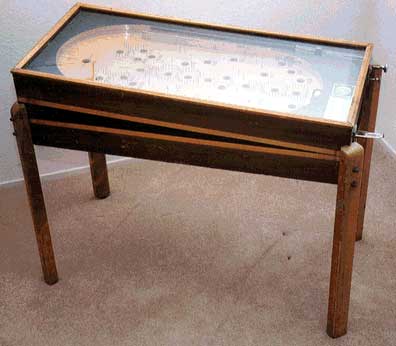
The first coin-operated pinball machines started showing up in the 1930's. The first pinball machines were made out of wood instead of metal like they are now, they did not light up, and they did not electronically track and display your score, instead scoring was tracked mechanically.
1950's
1951
PC Based Gaming - Nimrod
The Nimrod is a computer that allows users to play the game Nim. The Nimrod is known for being the first ever computer system to be designed specifically for playing a game.
The computer was created by a company named Ferranti in 1951 and revealed at the Festival of Great Britain in the same year.

1953
Interactive TV - Winky Dink & You
Winky Dink & You is the first ever TV show that was considered to be interactive.
 The way the show was interactive was through pieces of vinyl plays tic and crayons that were bought for the show, at certain points, the viewers were prompted to put the plastic over the screen and the would be given activities such as connecting the dots, filling in gaps to reveal a message, and even drawing a character that the hosts of the show will have a conversation with.
 This show was praised by Bill Gates for being the first interactive show.
1960's
1966Arcade Gaming - Periscope
Sega introduced an electro-mechanical arcade game called Periscope in 1966. This game was a light gun shooter/submarine simulator. It used lights and plastic waves to simulate the feeling of ships and submarines sinking into water. This arcade machine was the first ever to cost a quarter to play. This arcade machine became a huge success, mainly in Japan, Europe, and North America.
After seeing the success of Sega's first arcade machine, Tatio, a Japanese company, decided to make one of their own, this game was called Crown Soccer Special and was released in 1967. this game was a two player sports game that used electronic components to simulate football.
In 1969, Sega released another light gun arcade game since their first one was such a big success, this one was called Duck Hunt, the difference between this game and Periscope was that it featured moving targets to scoot, had sound effects where the volume could be controlled by the player, and printed out a ticket with the players final score on it after their game had ended.
Sega released two more arcade games in the same year as Duck Hunt, these games were Grand Prix and Missile.
Grand Prix was a first person driving game that featured an accelerator, steering wheel, and electronic sound.
Missile was a shooter and vehicle combat simulator, this featured a few new things such as a moving strip of film that was to represent the targets, and a joystick with a fire button,
1970's
In the 1970's, arcade games started to become a popular thing. This is also the decade that the first ever home video games console was released in, starting the first generation of home video games consoles.1971
Arcade Gaming - Galaxy Game
In 1971, the Galaxy Game was released, this was the first known coin operated arcade video game. Galaxy Game was a single machine that was set up at Stanford University and programmed by two students there; Bill Pitts and Hugh Tuck. The arcade game very quickly became popular on campus, with people waiting up to one hour, 30 minutes to be able to play it. The machine later included more consoles, allowing people to play against each other. To play Galaxy Game, it cost 10 cents for one play, or 25 cents for three plays. This arcade machine used a PDP-11, a 16-bit minicomputer with vector displays. Over time, the display processor in the machine became less and less reliable, and for this reason was removed from the campus in 1979. The Galaxy Game is now on display in the Computer History Museum in Mountain View, California.
1972
Arcade Gaming - Pong
In 1972, Atari Inc. launched the arcade game 'Pong'. Pong became the first commercially successful arcade game and was the first ever sports arcade game, the sport features in the game was tennis. Although not the first arcade video games to be made, it was one of the first ones to actually become popular. Pong was the first ever game to be developed by Atari, which was founded by Nolan Bushnell and Ted Dabney. Shortly after Atari was founded, a man named Allan Alcorn because they had previously worked with him before and because they known he had a good amount of experience in computer science and electrical engineering. After Alcorn was hired, Bushnell game him a task to create a simple game that had one moving object, two paddles, and numbers to track score. This task was meant to be a warm-up task and training to see if Alcorn was able to deliver. The fact that this was a training task was kept secret from Allan Alcorn, instead he was told that this game was needed as part of a contract with a company called General Electronic who needed a product. The aim of Pong was to hit a square back and forth between two players with a paddle until one player misses, giving the other a point, the game was played until one player reached 10 points, this gameplay was intended to simulate table tennis. Because of the popularity and success of Pong, many other companies began to copy the gameplay of Pong.
The success of Pong also got
Ralph Baer's attention, the creator of the Magnavox Odyssey, who noticed that
Pong seemed to be a copy of the game that Baer also created with the Odyssey,
this resulted in him filing a lawsuit against Atari. Magnavox's argument was
that Atari had gone against Baer's patents of an electronic ping pong game.
Bushnell admitted to seeing Baer's game before the creation of Pong. Lawyers on
Atari's side feared that they would not win the fight and estimated legal costs
of up to $1.5 Million, and this would have been more than Atari's own funding.
Magnavox offered Atari the chance to become a licensee to Magnavox for
$700,000, which Bushnell accepted. In addition to this contract, Magnavox would
get the rights to any Atari Products that were developed over the next year.
This resulted in Atari delaying the release of all products they'd made and
kept them secret to avoid Magnavox from obtaining the rights.

Pong, by Atari
Home Game Console - The Magnavox Odyssey (First Generation)
 Four of these games used the Light Gun to be played with, a peripheral for the Odyssey and the first ever light fun and peripheral in video gaming. The gun detected light from the TV screen when pointed and it and the player pulled the trigger, counting as a hit in the game.
1973
In 1973, Atari Inc. released their second arcade game, Space Race. This was one of the first games to allow more than one player to be playing at the same time. The main gameplay of Space Race was that two people controlled a spaceship, their goal was to make it from the bottom of their screen to the top, all while avoiding obstacles like asteroids and other spaceships. The background was simply black with white squares to look like a star-field and score was tracked and displayed electronically. A similar game was released by Tatio in the same year named Astro Race.
The Magnavox Odyssey is the worlds first ever home video games console released in August 1972, this games console is what started the 1st Generation of home video games consoles.
The Magnavox Odyssey was designed by a man named Ralph Baer. Baer came up with the idea for the console in 1966 and began working on a prototype a year later, which he finished by 1968. The prototype Baer created was simply known as the 'Brown Box'.
In 1972, the final product was finished, the Odyssey. The console was manufactured and licensed by a company named Magnavox, resulting in the console being renamed the Magnavox Odyssey.
The Odyssey was a digital games console, though many collectors of old games consoles often mistaken it for an analog console because of the fact that it used analog circuitry instead of digital circuitry, this was simply because that all televisions were analog. To avoid further confusion, Baer had to clarify to people that the console was digital.
The console could either be powered by 6 AA batteries or by an AC power cable which was sold separately.
The games controller was a small, simple, box shaped object with two paddles on the side which were used to control things in the games.
Games were inserted and started using a printed circuit board which was inserted into a small slot on the top of the console. There were a total of 27 games for the Odyssey across 12 different game cards, some cards had up to 5 different games on them.
The 27 different games released were:
•Tennis
•Analogic
•Baseball
•Basketball
•Brain Wave
•Cat and Mouse
•Dog Fight
•Football
•Fun Zoo
•Handball
•Haunted House
•Hockey
•Interplanetary Voyage
•Invasion
•Percepts
•Prehistoric Safari
•Roulette
•Shooting Gallery
•Shootout
•Simon Says
•Ski
•Soccer
•States
•Submarine
•Tennis
•Volleyball
•Win
•Wipeout
 Four of these games used the Light Gun to be played with, a peripheral for the Odyssey and the first ever light fun and peripheral in video gaming. The gun detected light from the TV screen when pointed and it and the player pulled the trigger, counting as a hit in the game.
Many small extras were included with the Magnavox Odyssey when bought; it was sold with multiple translucent pieces of plastic that were put over the TV screen when playing certain games, this added the look of things things like colour and environment to the game. For example, when playing the football game, a piece of plastic with a football field could be out over the TV. The games box also included things like poker chips, dice, fake money, boards, and score sheets to help play the game and track scores between players.
The Magnavox Odyssey was a huge success, having approximately 150,000 consoles and 125,000 games sold in just it's first year of being released. By 1974, only two years after being released, the amount of consoles sold reached 350,000.
1973
In 1973, Atari Inc. released their second arcade game, Space Race. This was one of the first games to allow more than one player to be playing at the same time. The main gameplay of Space Race was that two people controlled a spaceship, their goal was to make it from the bottom of their screen to the top, all while avoiding obstacles like asteroids and other spaceships. The background was simply black with white squares to look like a star-field and score was tracked and displayed electronically. A similar game was released by Tatio in the same year named Astro Race.
1974
Tatio released two more arcade
games a year later, in 1974. The two games that they released were Basketball
and Speed Race
Arcade Gaming - Basketball

Arcade Gaming - Speed Race
 Speed Race was a black and white
racing game, Speed Race was one of the first games that featured scrolling
graphics, sprites in the game moved along a vertical track from an overhead
view to make it appear as if the vehicle was moving. The controller is one of
the main things that made this arcade game stand out, it featured a realistic
steering wheel controller and even included things like a speed meter, an
accelerator and a gear shift. Speed Racer had an early stage of difficulty
levels, allowing the player to decide from either a 'beginners race' or an
'advanced race'. For its release in America, the game was renamed to 'Wheels'.
Speed Racer was one of the biggest influences for future racing games that came
after it. This game had a sequel in 1976.
Speed Race was a black and white
racing game, Speed Race was one of the first games that featured scrolling
graphics, sprites in the game moved along a vertical track from an overhead
view to make it appear as if the vehicle was moving. The controller is one of
the main things that made this arcade game stand out, it featured a realistic
steering wheel controller and even included things like a speed meter, an
accelerator and a gear shift. Speed Racer had an early stage of difficulty
levels, allowing the player to decide from either a 'beginners race' or an
'advanced race'. For its release in America, the game was renamed to 'Wheels'.
Speed Racer was one of the biggest influences for future racing games that came
after it. This game had a sequel in 1976.1975
Arcade Gaming - Gun Fight/Western Gun
 Gun Fight was an arcade shooter
created by Tatio and released in 1975. This arcade machine was the first one to
use a microprocessor, this allowed it to have better graphics and animations that
looked smoother. Gun Fight is a two player game where each player takes the
role of a cowboy, both armed with revolvers and facing each other in a duel.
Players are given six bullets each and must be the first to shoot and kill
their opponent while avoiding getting shot themselves, whoever gets the first
hit, wins. A point is earned for each duel that is own and each play gives more
than one chance to duel, if both players run out of ammo, the round will
automatically end and count as a tie. Players are able to move and shoot with the
two joysticks, an eight-way joystick for moving the cowboy around the screen,
and another for changing the shooting direction of their weapon. Billets in the
game can ricochet against the top, bottom, and sides of the screen, this allows
more strategy to be used when playing the game. Another thing that allowed
extra strategies to be used were obstacles in game that can be used to avoid
bullets, such as cacti, rocks, and stagecoaches. Once a player is shot, their
character will fall to the ground and the words 'Got Me!' will appear above
their body. This arcade game was the first to feature human-to-human combat,
something that had never been done before the release of this game. Gun Fight
was released as 'Western Gun' in places like Japan and Europe.
Gun Fight was an arcade shooter
created by Tatio and released in 1975. This arcade machine was the first one to
use a microprocessor, this allowed it to have better graphics and animations that
looked smoother. Gun Fight is a two player game where each player takes the
role of a cowboy, both armed with revolvers and facing each other in a duel.
Players are given six bullets each and must be the first to shoot and kill
their opponent while avoiding getting shot themselves, whoever gets the first
hit, wins. A point is earned for each duel that is own and each play gives more
than one chance to duel, if both players run out of ammo, the round will
automatically end and count as a tie. Players are able to move and shoot with the
two joysticks, an eight-way joystick for moving the cowboy around the screen,
and another for changing the shooting direction of their weapon. Billets in the
game can ricochet against the top, bottom, and sides of the screen, this allows
more strategy to be used when playing the game. Another thing that allowed
extra strategies to be used were obstacles in game that can be used to avoid
bullets, such as cacti, rocks, and stagecoaches. Once a player is shot, their
character will fall to the ground and the words 'Got Me!' will appear above
their body. This arcade game was the first to feature human-to-human combat,
something that had never been done before the release of this game. Gun Fight
was released as 'Western Gun' in places like Japan and Europe.1976

Arcade Gaming - Speed Race Twin
In 1976, Tatio released a sequel
to Speed Race, Speed Race Twin. Unlike its previous
game, Speed Race Twin now
had colour graphics and two player split-screen multiplayer.
A few more popular arcade games
were released in 1976, one by Sega and two by Atari, these were; Moto-Cross, Night Driver, and
Breakout.
Arcade Gaming - Moto-Cross/Fonz
 Moto-Cross was an early motorbike racing game released by Sega that played in black and white. This arcade game was noted for it's introduction to an early kind of three-dimensional third person. The game played from a third-person view of the player on a bike with a forward scrolling road that changed as it moved along. The game was controlled with a set of handlebars on the cabinet that were used to steer. The objective of the game is to get the furthest distance down the road as fast as possible within a set time, all while avoiding objects, other bikes, and driving off the road. To make the game more difficult as the player advanced, the game would flash a reverse image at certain points. Each game could be set from any time in between 45 and 100 seconds. Something that made this arcade machine stand out against the others is that it was the first to use haptic feedback, this caused the handlebars that the game was controlled with to vibrate when the player has a collision with another person or object. In America and some other parts of the world, the game was renamed to Fonz, based on the hit TV show at the time, 'Happy Days', the slogan of the game was also changed for Fonz, it was "TV's hottest name, your hottest game". Although it had a different name and slogan, the game was exactly the same besides being in a custom case.
Arcade Gaming - Night Driver
Night Driver is a first person arcade racing game released by Atari Inc. In this game, the gameplay consisted of the player controlling a car from a first person view at night, the player needed to avoid crashing into the side of the road or into other vehicles, which could be seen by road side reflectors and lights. After the player hits 300 points in the game, they are given bonus time, their remaining time will be doubled, the score counter resets to 0 after getting to 1000 points, making it possible for the player to get 300 points and extend their time more than once. Driving in the game was controlled by three main things; a gas pedal for driving, a wheel for steering the car, and a lever for shifting gears, with four different settings. This game has three difficulty levels for the player to choose from; Novice, Pro, and Expert, the more difficult the, the more points awarded, the player got to choose this before their game started. After choosing the difficulty, the game length could be set to either 50, 75, 100, or 125 seconds. Because of how limited the technology of arcade machines were at the time, the vehicle was not actually shown in game, instead it was printed over the screen. Because of the limitations of the technology, it was most likely easier to develop the game because it was set at night, meaning there is things to be drawn, like buildings.

1976
Arcade Gaming - Breakout
Breakout was another arcade game released by Atari. The concept of Breakout was thought of by Nolan Bushnell and Steve Bristow. The game was inspired by Pong and borrowed ideas from it.

The aim of the game was for the player to destroy eight rows of bricks, one by one, which filled the upper area of the screen, each row a different colour. Different coloured bricks were worth different amounts of points; Yellow were worth one, green worth three, orange worth five, and red worth seven. To destroy the bricks, the player used a movable paddle near the bottom of the screen to hit a ball up against the bricks, the ball was able to bounce against the sides of the screen and bounced back as it destroyed a bricks for the player to then hit back again. The player loses that turn when the ball hits the bottom of the screen because they failed to hit it back. To make the game more difficult, the ball sped up and the paddle got smaller the longer the turn lasted. Each player got three turns to use before they got game over. The player allowed up to two players, each alternating turns.
Just like Pong in 1972, Breakout became so popular that it caused a large amount of clones of the game to be made. Many games today still use mini games similar to Breakout. Mini-Games in Pinball, Major Havoc, and Sonic the Hedgehog (2006) were all based on Breakout. Peggle also used similar mechanics to Breakout.
1977
Arcade Gaming - Space Wars
Space Wars was released, this was a very early example of vector graphics in arcade games. In this game, two players controlled a ship each and battled against each other.
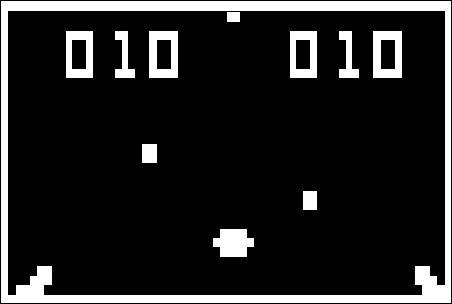 The game was played with 5 different buttons; one to rotate the ship left, another to rotate right, one to fire, one to activate thrust, and the last to enter hyperspace. The last button caused the ship to disappear from the screen and reappear in a random location.
Using all the options that were given to you to control your ship, the aim of the game was to shoot at your opponent until they had been defeated or until the timer ran out, each player getting multiple lives. Before starting, the players were allowed to turn certain gameplay features on or off, things like whether the edges of the screen were wrapped around to the opposite side, meaning if a player moves off the right side of the screen they will come back onto the left side, whether the shells fired were able to bounce of the top or bottom of the screen, and whether there was a star in the playing field that altered the pull of gravity as it moved.
Things that made the game stand out over others is the fact that it required two players, there was no option to play alone, players did not die after one direct hit, instead they took damage that would affect things like how fast the ship move or how often it could fire, and the duration of each game depended on the amount of money that was inserted before starting; the game lasted for one minute, thirty seconds per quarter, the game allowed up to ten dollars to be inserted, this allowed the game to be played non-stop for an hour.
Home Game Console - Colour TV-Game (Second Generation)
The colour TV-Game is one of the earliest home video games consoles and is the first to be released by Nintendo. This console was released only in Japan and was never sold anywhere else.
 Games for the Colour TV-Game included things like Light Tennis, a similar game to Pong, Racing, a birds eye view racing game, block breaker, based on Atari's hit arcade game Breakout.
 The game began gaining a massive amount of popularity when it obtained the license of the hit arcade game Space Invaders by Tatio in 1980, which doubled sales from 1 million units to 2 million.
Home Game Console - Colour TV-Game (Second Generation)
The colour TV-Game is one of the earliest home video games consoles and is the first to be released by Nintendo. This console was released only in Japan and was never sold anywhere else.
This games console was powered by four C batteries.
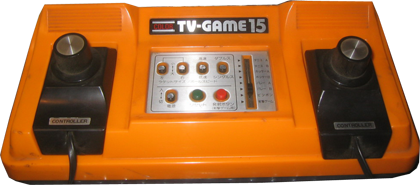 Games for the Colour TV-Game included things like Light Tennis, a similar game to Pong, Racing, a birds eye view racing game, block breaker, based on Atari's hit arcade game Breakout.
The game console was successful in Japan but did not earn massive amounts of money due to it not being released anywhere else.
Home Game Console - Atari 2600 (Second Generation)
The Atari 2600 is a second Generation home video console released by Atari Inc. that is well known for making the use of the microprocessors in games consoles popular.
The console was launched including two joysticks and a game called combat in the box, as well as eight games that were sold separately.
 The game began gaining a massive amount of popularity when it obtained the license of the hit arcade game Space Invaders by Tatio in 1980, which doubled sales from 1 million units to 2 million.
Though most of its popularity came from Space Invaders, the consoles most popular and best selling game was a port of Pac-Man, which sold a total of 7 million copies.
The Atari 2600 used a 1.2MHz MOS Technology 6507 main processor, a TIA 1MHz sound processor, 128 Bytes of RAM, and was capable of displaying games at a maximum resolution of 160 x 192 Pixels.
1978
Although the exact start and end date are known and are different for many people, most people would mark 1978 as when the Golden Age of Arcade Video Games began. By this time, the technology that was being used became much more advanced. Although still very basic, it has become advanced enough to allow higher quality graphics and sounds. Arcade games still needed to be kept simple yet fun and entertaining, but developers now had more to work with, allowing for more creativity and ideas to be used, resulting in more successful games. It was at this point that most arcade game developers began experimenting and using vector display graphics, which allowed for better looking games.
The success of the arcade video game 'Space Invaders' by Tatio is said to be responsible for starting the Golden Age of Arcade Video Games.
Arcade Gaming - Space Invaders
Space Invaders was a 2D fixed shooter arcade game where the player controls a laser cannon which moves left and right across the bottom of the screen. The aim of the game is for the player to shoot upwards at rows of aliens that descend down the screen towards the cannon as the game progresses, each play gives the player three lives to defeat five rows of eleven aliens, earning points for each one killed. The aliens will attempt to fight back by shooting at the cannon to destroy it, once the aliens successfully reach the bottom of the screen or destroy the cannon, the game will end. To avoid being hit by the aliens firing, the player has four barriers on screen that they are able to hide behind, over time the barriers will break if shot enough. If the player manages to defeat all aliens in the wave , another more difficult wave will begin. If a player is skilled enough to keep defeating waves without losing, they could play on a continuous loop without the game ending.

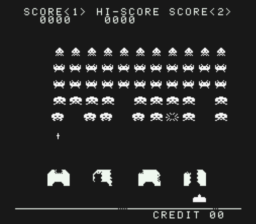
Creator of the game, Tomohiro Nishikado had to design his own custom hardware and development tools to run the game, the reason for this is because microcomputers in Japan were not powerful enough to handle the task of designing and programming a game. Nishikado eventually created the arcade game board using the new microprocessors that were from America. The CPU that the game uses is an Intel 8080, the sound was created by using analogue circuitry and a Texas Instruments SN76477 sound chip, and the game itself was displayed using a CRT Monitor.
Although Nishikado had got specially made custom hardware, he found he was still unable to make the game exactly as he wanted it, he wanted the aliens to move faster and the game to display in colour but was unable to do it. Continuing to develop the game, Nishikado eventually realised that he was able to make the aliens move faster if there was less of them on the screen. Instead of removing some aliens to make the game work with his current hardware and have the game how he originally wanted, he instead decided to make it a challenging gameplay mechanic, having them speed up as more were defeated, allowing the game to get more difficult as it progresses.
The sound effects and music in the Space Invaders was still very basic, but at the time was considered revolutionary compared to other games released around its time, which only had a short opening theme, a short game over theme, and basic sound effects. Space Invaders instead had continuous playing music during the game, plus sound effects for the cannon and aliens firing, and sounds when an alien was killed. What stood out mostly about the game was that other sound effects could play without interrupting the music playing in the background. The music in the game was very a very simple four-note loop but stood out because it had never been done before.
After just a few months of being released only in Japan, Space Invaders became one of the most popular arcade games ever with new arcades opening with nothing but Space Invaders to play. By the end of the release year, Tatio had sold over 100,000 machines in Japan alone, earnings Tatio over $600 Million. By 1980, only two years after release, over 300,000 Space Invaders Cabinets had been sold in Japan plus another 60,000 in the United States. The arcade machines sold for approximately $2,500 each. By 1981, over $1 Billion worth in quarters had been used on Space Invaders machines, and this amount doubled to $2 Billion by 1982, this amount of money is now worth around $7.3 in 2014. For the next few years Space Invaders continued to earn Tatio an average of $590 Million a year. The game also ended up being ported to home consoles like the Atari 2600, which was the first console version that was officially licensed, this resulted in the consoles sales quadrupling in less than a year. it was also ported to the Atari 5200 and NEA in 1986. With the amount of money it was earning, Space Invaders became the highest-earning entertainment product of its time. Like all other popular arcade games at the time, many unofficial clones of it were made, some of these being Super Invader, and TI Invader.
1979
Arcade Gaming - Asteroids
Asteroids was an arcade, space themed shooter game released by Atari Inc. It was designed by two people; Lyle Rains and Ed Logg.
The main objective of Asteroids is for the player to control and guide a spaceship through an asteroid field, shooting flying saucers and asteroids in your way to avoid colliding with them. Each game beings with a small number of large asteroids which the player must shoot, this causes them to break into smaller asteroids which must then be destroyed. Later, flying saucers will enter the game and being shooting at the player, these must also be avoided and destroyed. Points were earned in game as obstacles were destroyed, the game increases in difficulty as the player reaches 40,000 points, and once more at 60,00 points. Increased difficulty makes more obstacles appear on screen and more frequently, and also makes flying saucers more accurate when they shoot at you. There was a bug in this game that caused it to slow down, the cause was because of lives in the game; the player would start with three lives and earn an extra life for every 10,000 points earned, once the player earned around 50 lives, the game would being to slow down and continue getting slower as more lives were earned, this problem is caused by a programming error where a maximum lives limit has not been set.

The games controls were influenced by Spacewar, it used the same game physics and five button layout to control the ship.
Lyle Rains originally had the idea for the game to be made using raster graphics, but changed his mind after Ed Logg, who already had experience with vector graphic, talked to him about how firing in the game could be accurate and precise if done using vector graphics.
The game uses a QuadraScan, a high resolution graphics processor that was created by Atari, who also call it the 'XY Display System', and an MOS 6502 to run the game program.
Asteroids became popular almost instantly after release, it sold over 70,000 machines, earned Atari over $150 Million, and earned all arcade operated a total over over $500 Million overall, this made Asteroids Atari's best selling arcade video game.
1980's
1980
Arcade Gaming - Pac-Man
Pac-Man is a an arcade game that was developed by Namco and became almost instantly popular on release. The game became so popular that it resulted in there being Pac-Man branded items, it's own TV show, and a top-ten hit single. Pac-Man stood out for the reason that, at the time of release, the most popular arcade games were space themed, like Space Invaders and Asteroids. Pac-Man created a new genre of arcade video games that appealed to everyone.
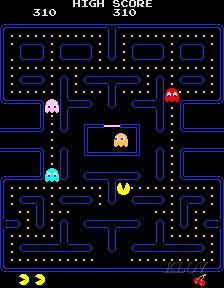 The aim of the game is for the player to move Pac-Man, a small, round, yellow character, through a blue maze collecting Pac-Dots, once all dots are eaten, the player will progress to the next stage. To add more difficulty to the game, Pac-Man must avoid four different coloured ghosts while moving through the maze, if touched,, the player will lose a life and be returned to the starting point of the Maze, the player begins with three lives and once all lives are lost, the player will get game over and the game will end. In certain areas of the maze, four larger, flashing dots will be placed, once eaten, all ghosts that are currently in the playing area of the maze will turn blue, slow down, begin moving away from Pac-Man, and become vulnerable to him, while this is happening, the player is able to eat the ghosts, giving them extra points and leaving only the eyes of the ghosts, which then travel back to the centre of the maze and regenerate. As the player progresses further through the game, the mazes will be come larger, the enemies smarter, and ghosts faster.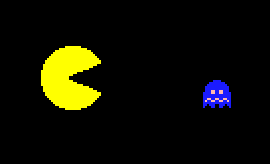
The Pac-Man arcade machine uses a ZiLOG Z80 3MHz Processor and uses a Namco WSG 3MHZ Sound processor. the screen displayed at a resolution of 224 x 288 and could display 16 colours at once.
Pac-Man was originally supposed to be called Puck-Man, because of his shape, which resembled a hockey puck, but was later renamed to Pac-Man because developers thought that that may be too easy for players to vandalise arcade machines by replacing the the letter 'P' with the letter 'F'.

Because Space Invaders was still very popular in Japan at the time, Pac-man turned out to be much more successful in America instead. In just 18 months, Namco had sold over 365,000 arcade machines for approximately $2,400 each, earning Namco around $1 Billion. By 1982, it had been estimated that almost 30 million Pac-Man players were still actively playing and that $7 Billion in quarters had been inserted into the machines overall.
Pac-Man is considered to be one of the best arcade games to be made and was the first to introduce the maze-chasing genre of video games and is still played today, it has a large number of sequels and remakes that have been made and are still being made, and Pac-Man is often used as an icon to represent gaming as a whole.
1981
Arcade Gaming - Donkey Kong
Donkey Kong is an Arcade game released by Nintendo, it is one of the earliest examples of a platform type game and helped platform games become a genre of games.
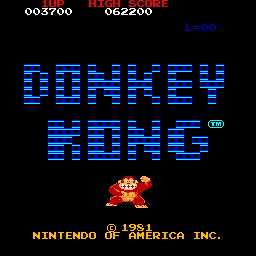
The name of the game, 'Donkey Kong', which is also name of the enemy in the game, an ape, originated through the creator of the character, Shigeru Miyamoto thinking that the word 'donkey' translated to 'stupid' in English, he then used the word 'Kong' after, which was used in Japan to describe a large ape, believing that the result would be the translation 'Stupid Ape' . Once Miyamoto had finished his idea, he presented it to Nintendo in America, who laughed at him for the name. Although he was laughed at and the name was a mistranslation, it still stuck and remained the name of the character.

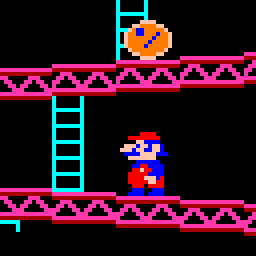
The player took control of a character named Jumpman, who had to rescue a damsel in distress from a large ape named Donkey Kong. The player started the game at the bottom of the screen and Donkey Kong at the top, they'd get three lives, they had to jump onto platforms to get higher and higher up the screen, all while avoiding enemies and barrels that Donkey Kong threw down. Once they reached the top, Donkey Would run away with the girl and the next level would begin, this would repeat until all four stages have been completed with each level getting more difficult by including things like more enemies, fireballs, burning oil barrels, and gaps in the structure that needed to be climbed. if the player makes contact with any of the obstacles during a level, they will lose a life and be sent back to the start As the player progressed up the stage, they would earn points for many different things like; jumping over barrels and enemies, destroying objects with the hammer power-up in the game, and collecting things like hats and purses, which are thought to belong to the damsel in distress This game was considered one of the most difficult arcade games of it's time.
The hardware that was used in the Donkey Kong arcade machine was a 3MHz ZiLog Z80 for the main processor, an I8035 400KHz sound processor, DAC sound chips, and a monitor with a resolution of 224 x 256 that displayed 256 colours and rater graphics.
Donkey Kong still remains a popular character in Nintendo and still has a number of his own games being released. Jumpman, was later renamed to Mario, and has since became Nintendo's most popular video game character and icon and is even on of gamings most known characters


1982
Arcade Gaming - Pole Position
Pole Position is a racing arcade game released by Namco. The game was developed by the same person that created the Pac-Man game in 1981.
On starting the game, the player took control of an F1 Racing Car, and had the objective of completing a lap around a racing track within a set amount of time in order to qualify and compete in an F1 race against other computer-controlled racers at the Fuji Racetrack. Being able to compete at the Fuji Racetrack in game made this the first racing game to feature a circuit that was based on a real life race track, as well as this, it was the first game to require a qualifying lap to be done in order to race against other drivers too. While racing, the players goal is to finish the race in the best place possible within a certain time, this must be done while avoiding crashing into opponents and signs along the sides of the circuit.
Racing in the game was controlled slightly differently depending on the games cabinet. The cockpit-styled cabinet featured a steering wheel, gear shifter, accelerator pedal, and a break pedal, but the regular upright type cabinet featured the same but without the break pedal, meaning the player was unable to break in game if playing with the upright cabinet.
 The game ran on Namco's own made hardware which they named 'Namco Pole Position Hardware', this was the first arcade game hardware to use 16-bit microprocessors with two Zilog Z8002 3MHz processors, this allowed for smoother, faster, better looking graphics. As well as this, the game ran using one Zilog Z80 3MHz CPU and one 256KHz MB8844 CPU. For the games sound, a Namco WSG and a Namco 52XX sound processor was used. The game displayed with a resolution of 256 x 224 and was capable of displaying 3840 colours.
Other companies were advertised in the game on signs that the player drove past while racing, company logos for Pepsi and Canon were frequently seen during the game. Because of this, Pole Position is a very early example of product placement in video games.
By the end of the year, Pole Position became the highest earning arcade video game of 1982, selling over 21,000 machines, which earned approximately $61 Million. Pole Positions popularity resulted in a morning TV show of the same name and a sequel a year later. Many people refer to Pole Position as one of the most important racing games to ever be made, being the influence for many of the racing games that game after it
1983
1983 was the year of a video game crash, during this year, the overall revenue of the video games industry dropped from around $3.2 billion to less than $100 Million. this crash was responsible for ending the second generation of home games consoles and caused bankruptcy for most of the big game companies at the time.
There are many things that are considered to be the cause of the crash, the main ones were:
-The Competition of Personal Home Computers - Home computers were becoming increasingly popular at the time, which drew a lot of attention from games consoles.
-Large Amount of Consoles and Games Being Released - There was many different home video games consoles being released around this time. Many with very popular games, but with the popular games, came a lot of failed games, which massively reduced sales of the consoles. One of the games thought to be the main cause for the crash was E.T. The extra terrestrial, which was said to be one of the worst games ever created since it was rushed out to be released with the movie.
-Console Failures - Many games consoles at this time had been reported to have stopped working or have many noticeable faults.
1983 was the year of a video game crash, during this year, the overall revenue of the video games industry dropped from around $3.2 billion to less than $100 Million. this crash was responsible for ending the second generation of home games consoles and caused bankruptcy for most of the big game companies at the time.
There are many things that are considered to be the cause of the crash, the main ones were:
-The Competition of Personal Home Computers - Home computers were becoming increasingly popular at the time, which drew a lot of attention from games consoles.
-Large Amount of Consoles and Games Being Released - There was many different home video games consoles being released around this time. Many with very popular games, but with the popular games, came a lot of failed games, which massively reduced sales of the consoles. One of the games thought to be the main cause for the crash was E.T. The extra terrestrial, which was said to be one of the worst games ever created since it was rushed out to be released with the movie.
-Console Failures - Many games consoles at this time had been reported to have stopped working or have many noticeable faults.
Arcade Gaming - Libble Rabble
Libble Rabble was released by Namco and was created by the same one person that made Namco's previous two popular games, Pac-Man and Pole Position.
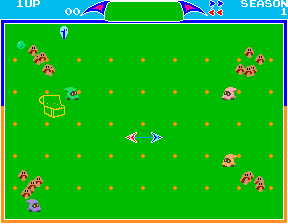 Gameplay in Libble Rabble has the player controlling two arrows, a red arrow named Libble and a blue arrow named Rabble, both connected by a line between the two. The goal for the player is to wrap the line connecting the two arrows around poles in the playing area, creating a closed loop around small mushroom like creatures called Mushlings to harvest for points. To stop the player, different types of enemies will wander around, causing the player to lose a life if they make direct contact with either of the arrows. To stop the enemies in the game, the player must do the same thing that is done to harvest Mushlings, trap them in a closed loop with the line, doing this will send the enemies to the top edge of the playing area for a short amount of time.
The game used three CPU's; two Motorola M6809 Processors each running at 1.5MHz, and a Motorola 68000, which ran at 6.1MHz, this was the first time Namco had used a processor like this. For sound, the machine used a Namco WSG. Libble Rabble displayed with a resolution of 288 x 244.
Home Game Console - Nintendo Entertainment System (Third Generation)
The Nintendo Entertainment System, commonly abbreviated and known as the NES, is an 8-bit home video game console created by Nintendo. This game was originally only released in Japan under the name Nintendo Family Computer (Famicom), but was released in America and other countries in 1985.
Home Game Console - Nintendo Entertainment System (Third Generation)
The Nintendo Entertainment System, commonly abbreviated and known as the NES, is an 8-bit home video game console created by Nintendo. This game was originally only released in Japan under the name Nintendo Family Computer (Famicom), but was released in America and other countries in 1985.
Nintendo employee, Masayuki Uemura, came up with the idea for the NES, wanting to build a 16-bit, cartridge based home video games console that would work as a computer, with a keyboard, mouse, and floppy disks. When presenting the idea to the President of Nintendo at the time, part of his idea was rejected due to him believing that keyboards, mice, and floppy disks for a home video games console would be too complicated for users. Although the idea of the console working as a computer wasn't liked, the President of Nintendo did like the idea of creating a console.
Prototypes of the NES were started to be worked on in 1983 with the projects code name being 'GameCom', with one being complete by the end of the year. While being worked on, Nintendo had been careful to make sure that their console did not face any of the problems that other consoles and arcade machines did, one of the main thing that they took extra care with was the game cartridges and cartridge slot, making sure games didn't fit in loosely causing the game to stop working, which is a problem that many other consoles at the time faced.
The controller that was built for the NES was a simple rectangle shaped piece of plastic with a D-Pad and two buttons, labelled 'A' and 'B'
The controller that was built for the NES was a simple rectangle shaped piece of plastic with a D-Pad and two buttons, labelled 'A' and 'B'
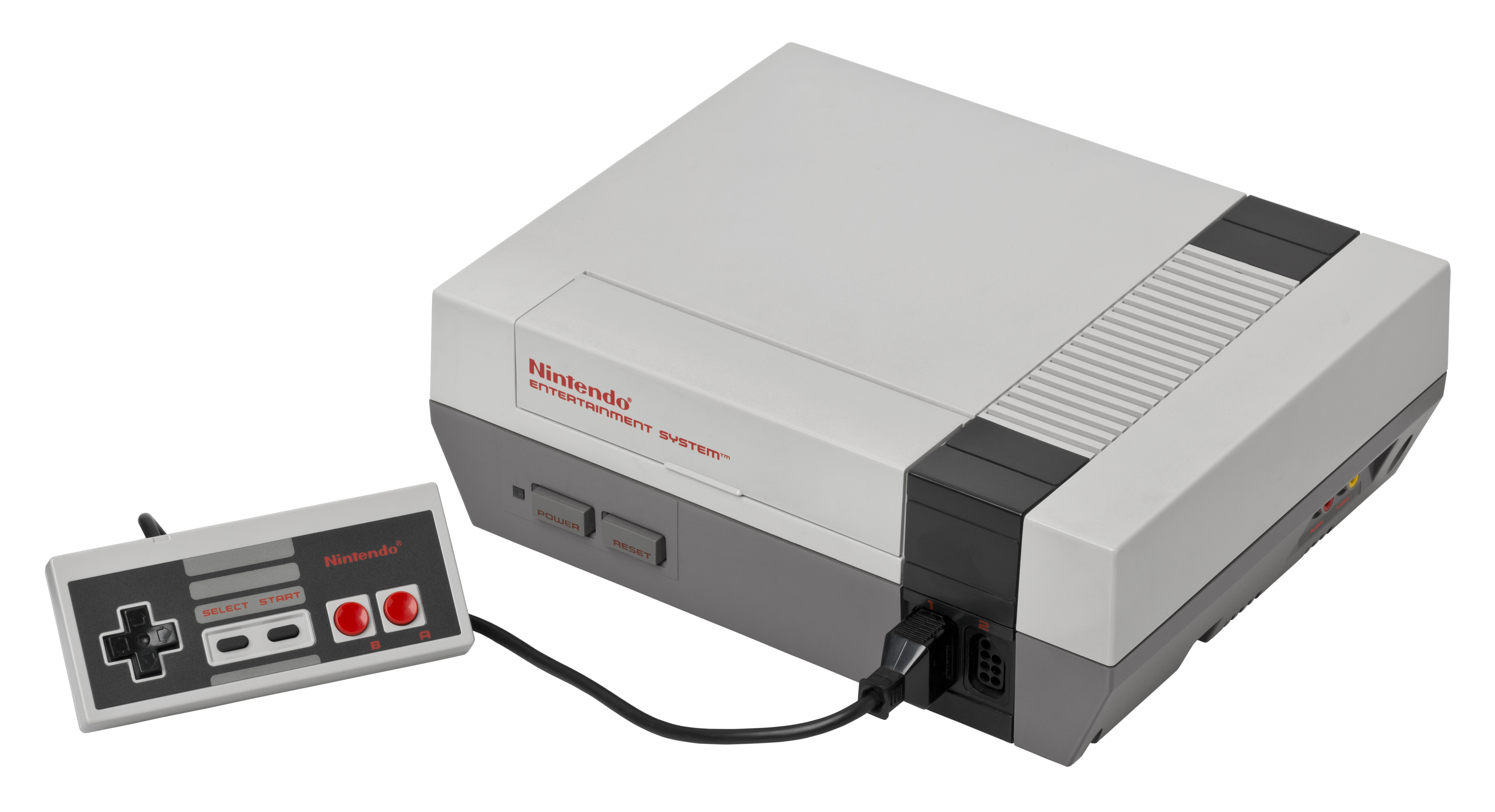
When finally released, the games console came bundled with two controllers and three ports of popular arcade games; Donkey Kong, Donkey Kong Jr, and Popeye. The NES took it's time to gain popularity due to being built with a faulty chip-set which caused the system to crash on starting up, this was later fixed in a remodeled version that came out in 1984, a year after its original release.
The NES ended up being the most popular and best-selling console of it's time and played a big part in helping to rebuild the video game industry after it's 1983 crash.
With the NES came the start of many of Nintendo's and gaming as a whole's most popular game series' with the release of game like Super Mario Bros., Metroid, and The Legend of Zelda, all of which are still having new games made today.
The hardware used in the NES was also pretty advanced for it's time, it used a Ricoh 2A03, an 8-bit microprocessor that runs at 1.8Mhz, 2KiB of RAM, a Ricoh RPC02 Picture Processing unit that was custom made for Nintendo, and a custom sound board that was able to support a total of five different sound channels.
After a poor start, The NES suddenly gained a massive amount of popularity and by 1998, the demand for NES Game cartridges was larger than any other home computer software. Within 8 years of being released, over 35% of Americans owned a Nintendo Entertainment System, making it the most owned computer system of it's time.


The hardware used in the NES was also pretty advanced for it's time, it used a Ricoh 2A03, an 8-bit microprocessor that runs at 1.8Mhz, 2KiB of RAM, a Ricoh RPC02 Picture Processing unit that was custom made for Nintendo, and a custom sound board that was able to support a total of five different sound channels.
After a poor start, The NES suddenly gained a massive amount of popularity and by 1998, the demand for NES Game cartridges was larger than any other home computer software. Within 8 years of being released, over 35% of Americans owned a Nintendo Entertainment System, making it the most owned computer system of it's time.
1984
Arcade Gaming - I, Robot
I, Robot is an arcade shooter released by Atari. The I, Robot arcade machine came with a second game, Doodle City, which is a short drawing game that lasts only for three minutes. Before being named I, Robot, the game was previously called "Ice Castles".
 In this game, the player plays as a robot, who's only job is to be a servant. At the beginning of the game, the servant robot becomes self-aware and makes the decision to rebel against a higher authority named 'Big Brother', who watches over servant robots with a giant blinking eye. The objective of the game is to navigate the servant robot through 126 levels, each filled with red blocks that must be walked over and turned blue, which destroys the eyes shield, allowing the player to directly attack and destroy it to advance to the next level.
Because of the technical limitations, only 26 out of 126 of the games levels are unique, after the 26th, the same levels repeat but at a higher difficulty.
I, Robot is know for being the first ever arcade video game to do two things; it was the first to use 3D Polygon Graphics and shading, and was the first that allowed the camera to be freely moved during the game.
Arcade Gaming - Doodle City
The second game that could be played on the same machine alternatively to I, Robot was Doodle City. Doodle City was a very basic drawing tool which allowed the player to freely draw and place and move around objects on the screen, objects left a trail behind when moved. A player was allowed to spend three minutes on Doodle City per credit inserted and had the option to switch back to I, Robot at any point, but with less lives depending on how much time time they spent drawing, the player would have one less life per minute spent on Doodle City.
The hardware used inside the I, Robot arcade machine is a Motorola 6809 processor which ran at 1.5MHz, a second custom 3D processor named bit-slice which allowed almost 2,000 polygons to be processed every second. For sound, four of Atari's own digital sound circuit was used, the Pot Keyboard Integrated Circuit, shortened to and more commonly known as POKEY. The game displayed at a resolution of 256 x 232 Pixels.
Although doing new things that made the game stand out among others, the game was unsuccessful. Only around 1000 - 1500 I, Robot machines were created, and only a small amount of that number have been confirmed to exist at all today, making these arcade cabinets extremely rare, collectible, and expensive. It was at one point rumoured that over half of the I, Robot machines created were dumped into the ocean because of it's lack of success, but this rumour was later confirmed to be false. Many people believe the game was unsuccessful because of its different style form the other popular games at the time, and others blame the North American Video Game Crash in 1983 for its lack of popularity.
1985
Arcade Gaming - Space Harrier
Space Harrier is a third person rail shooter that was released by Sega and created by Yu Suzuki. It was one of the first arcade games to use 16-bit graphics.
Space Harrier puts players in an area called the Fantasy Zone, where they are forced and automatically moved around the level having to shoot enemies that are in the way and having to kill a boss at the end of each one, this pattern repeats for all 18 unique levels. Space Harrier was controlled using an analog stick.

1986
Arcade Gaming - Bubble Bobble
Bubble Bobble is an action-platform arcade game released by Tatio. The game features two main characters, twin dragons named Bub and Bob.
 The game is played with up to two players each taking control of either Bub or Bob, the aim of the game is to rescue their girlfriends who have both been kidnapped by finishing all 100 levels. To get through levels, players will have to navigate through them by jumping up on platforms and avoiding or defeating enemies by blowing bubbles to trap them in and then popping the bubbles, defeated enemies drop food which is then eaten to earn points in the game.
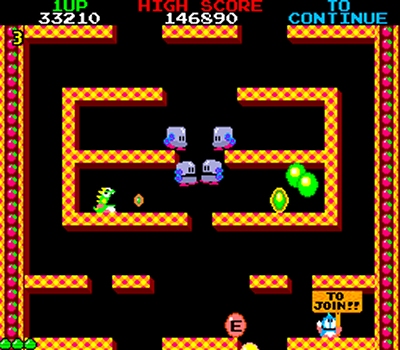 The CPU's used for the Bubble & Bobble arcade machine were two Zilog Z80's running at a total of 6MHz and one Motorola 6800 1GHz processor. For sound, a Yamaha 2203 3MHz sound processor was used. The games resolution was 256 x 224 and the game could display 256 colours.
1987
Many people consider 1986 to be the final year of the Golden Age of Arcade Gaming. The first main reason for this was because of the large amount of copies of popular arcade games that were being made, the copies became more common than the originals in arcades because they were very similar and a lot cheaper, this slowly caused the revenue of arcade gaming as a whole to drop from $8 Billion to $4 Billion from 1981 to 1986, just five years.
The second main cause for arcade machines becoming less and less popular was the release of computers and home video games consoles being released, which both ended up taking most of the attention that arcade games received and putting it on themselves.
By 1991, the arcade gaming industries had almost halved to $2.1 Billion, this meant that by this point, an arcade game only needed to sell 4,000 - 5,000 units in order to be considered a successful hit.
Arcade Gaming - Double Dragon
Tatio releases Double Dragon, one the first arcade games of the beat 'em up genre of games. Double Dragon was a huge success, resulting and sequels and inspiring other companies to attempt to add their own games to the genre.
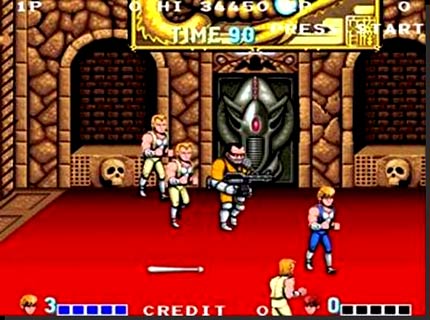 Double Dragon puts up to two players in control of one of two brothers. Who must fight their way through enemies across four levels to save a girl named Marian. Players fight enemies in the game with melee attacks and weapons only, using basic jumping, punching, and kicking to fight, or picking up weapons ranging from bats and knives to whips and dynamite. The game ends in two different ways depending on whether there is one player or two. If one player, the game will end normally, with the player winning Marian. If two players, each player will have to fight against each other at the end of the game to decide which one of them win her. The game is controlled using a joystick and three different buttons, one for each default move.
The Double Dragon arcade machine used multiple 8-but processors, one Hitachi HD6309 processor running at 12MHz, and a secondary processor, the Hitachi HD63701, which wan at 6MHz. Sound in the game was done using a Motorola M6809 1.Hz sound processor and the sound chip used was a Yamaha M2151.
The game displayed at a resolution of 256 x 240 pixels and could display 384 different colours.
Overall, the arcade game was a success and received good reviews, resulting in fours sequels that came later, ports to consoles, and an iPhone remake in 2011. Though the arcade game did well, the ports to consoles did not, mostly lacking certain features, and the Sega Mega Drive not being related to the original in any way, it was considered one of the worst Mega Drive games ever made.
1988
Arcade Gaming - NARC
NARC is an arcade run and gun shooter released by Williams Electronics. NARC was one of the first ever extremely violent arcade games and was one of the ones to feature and reference drugs in game.
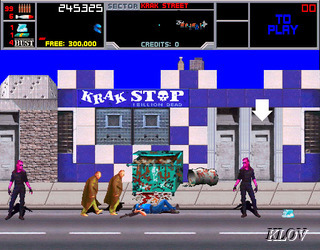 The game gives players the control over one of two main characters, Max Force and Hit Man, who are given an assignment named Project NARC, which comes with the mission of catching a man named Mr. Big the head of a drug trafficking organisation. Equipped with an automatic rifle and a rocket launcher, the player must work their way through levels by shooting or arresting drug dealers and junkies that get in your way, then defeat a ringleader at the end. At the end of each level, the player was presented with a tally like display to show how many enemies were killed, how many arrested, the total amount of money and drugs that were confiscated, and then a score depending on how the player played, players earned more points for arresting players over killing them. NARC was an early example of blood and gore in video games, with enemies exploding into burnt and bloody body parts when killed with the rocket launcher.
The NARC arcade machine was the first ever arcade machine to IDE a 32-bit processor instead of 8-bit and 16-bit processors. The 32-bit processor that was used in the machine was a Texas Instruments TMS34010 which ran at 6MHz, which allowed for much better and smoother looking graphics than other arcade games released around the same time. The sound processor used in the machine were two Motorola 6809 2MHz processors, and two sound chips; the Yamaha YM2151 and the Harris HC55536 CVSD. NARC displays at a medium resolution on a CRT monitor.
NARC received both an equal amount of positive and negative reviews, the positive calling it an enjoyable game, and the negative reviews calling it repetitive, boring, and one reviewer described the plot as "nonsense". Whether the reviews were good or bad, the game was criticised by all for how violent and bloody it was, parents often complained about it too, explaining how it was unsuitable for younger players. The game also had a remake made which was released on the PlayStation 2 in 2005.
Home Game Console - Sega Megadrive (Fourth Generation)
 The Genesis, known as the MegaDrive outside Japan, is a 16-bit, fourth generation console released by Sega in 1988. The Genesis was made in an attempt to rebuild the still-struggling game industry that was affected by the crash.
When launched, the MegaDrive was only released in Japan and was released in the rest of the world a year later, the game gained a massive amount of popularity with the release of it's best selling game, Sonic the Hedgehog, which is still a very popular game series today with new games being added.
 Sonic the Hedgehog was created to help the console compete with the Nintendo Entertainment Systems console and popular game character, Mario. This character later became a mascot for the company.
Home Game Console - Sega Megadrive (Fourth Generation)
 The Genesis, known as the MegaDrive outside Japan, is a 16-bit, fourth generation console released by Sega in 1988. The Genesis was made in an attempt to rebuild the still-struggling game industry that was affected by the crash.
 When launched, the MegaDrive was only released in Japan and was released in the rest of the world a year later, the game gained a massive amount of popularity with the release of it's best selling game, Sonic the Hedgehog, which is still a very popular game series today with new games being added.
 Sonic the Hedgehog was created to help the console compete with the Nintendo Entertainment Systems console and popular game character, Mario. This character later became a mascot for the company.
The hardware used in the Sega Genesis was a Motorola 68000 6MHz main processor that works alongside a Zilog Z80 2MHz secondary processor, there is a total of 136KB of RAM, a TExas Instruments SN76489 programmable sound generator card and a Yamaha YM2612 sound chip. The console was capable of displaying a pallete of 512 different colours.
1989
Hard Drivin'
Hard Drivin' is an arcade driving game released by Atari, known for being one of the first to use 3D polygons for its graphics.
The player of the game is given a first person view of a driver of a sports car, they must make their way around a stunt track, avoiding obstacles in the road and other vehicles, In the fastest possible time. If the player successfully finished the track within a good enough time to qualify for the Top 10 list on the high scores, they would then race against a computer controlled driver, acting as a bonus level.
The game was controlled with a wheel for steering, and an acceleration and break pedal.
One thing that was a first for racing games and that made Hard Drivin' stand out over games is it's 'Instant Replay' feature, when a player had a collision, the game will put them back on the racetrack at a time a few seconds before the mistake, allowing them to correct themselves. This feature was later used in many games after it.
Another thing that the game was noted for was the graphics, the entire race circuit was made up of 3D polygons, something that had never been done before at the time.
The game displayed on a CRT Monitor at a resolution of 504 x 384.
Overall, the game was successful and resulted I'm four sequels to it being created in the future.
1990
Pit-Fighter
Released by Atari, Pit-Fighter is an early arcade competitive fighting game which used digitalised graphics.
Gameplay in Pit-Fighter begins with up to three players each choosing a selected character to fight with and battling together against computer controlled opponents each other by jumping, kicking, and punching their opponent until they are out of health. Each selectable character has a different moves, levels of speed, and power. Players go through the game winning battles until they reach the final championship match where they must defeat and unnamed opponent to beat the game. The game is controlled using a joystick and three buttons; the joystick to move, one button to jump, one to kick, and one to punch. Pressing all three buttons at once will activate that players super move, dealing a lot of damage.
Something that the game was noted for was its use of digitalised graphics of live actors. Hired actors had moved and posed in front of a camera for the fighters, this footage was then put into the game with certain parts playing to match the buttons the player pressed. Graphics made with footage of live actors were on of the first to be used for this game, which became popular and influenced a lot of other games to attempt it to.
Pit-Fighter uses one Motorola 68000 processor which was capable of running at 14.3MHz, a 10MHz ADSP2105 sound processor, and a YM2151 sound chip. The game is displayed at a resolution of 336 x 240.
All reviews that Pit-Fighter revived were positive and the game was an inspiration to fighting games that came after it, it was praised for its use of digitalised graphics.
1991
Golly! Ghost!
Golly! Ghost! is an arcade shooter released by Namco.
Gameplay in Golly! Ghost! consists of up to two players shooting a certain amount of ghosts that appear on screen within a set amount of time to earn points. The game is played using light-gun controllers, one blue, and one red. The game has four levels to complete, each getting increasingly more difficult.
This arcade machine is ticket based, meaning players are awarded a certain amount of tickets depending on how many points were scored.
The game overall was considered a success, this ended up with a sequel being created just a year later, Bubble Trouble: Golly! Ghost! 2. The sequel was ocean and sunken treasure themed.
1992
Mortal Kombat
Released by Midway Games, Mortal Kombat is an arcade fighting game influenced by 1990's Pit-Fighter.
Players must have one-versus-one melee combat battles against computer controlled opponents. Before the game began, players were given a choice of a fighter, there were seven different characters to choose from.
The aim of the game is to be the first to deplete the health bar of an opponent, which is displayed at the top-right of the games screen, opposite to the players. Five buttons and a joystick were use to control the fighters different moves, the five buttons are laid out in an X shape; the upper two are used for high-kicks and high-punches, the lower two for low-kicks and low-punches, and the middle button for blocking enemy attacks. The joystick used for the arcade machine is an eight-way joystick, which was used to move the character around the screen, let them jump, and made them able to do alternative moves if pushed in a certain direction in combination with one of the attack buttons, an example one of these alternative moves was an uppercut, special moves were also triggered using the joystick, by rotating it in a certain direction and tapping it, this way of activating special moves was unique to Mortal Kombat and had never been done before in any fighting games that came before it. At the end of battles, when the players had gotten their opponents health low enough, they were able to do something called a 'Fatality', this involved executing the opponent in a gruesome way, some examples were; ripping the opponents body parts off or crushing their opponent. Co-Developer of the game, Ed Boon's favourite Fatality in the game was the 'Spine Rip', which invoked ripping the opponents spine out of their body to finish them off.
The hardware that is used in the Mortal Combat arcade machines is a TMS34010 6.2MHz main processor, a Motorola 6809 sound processor, and a Yamaha YM2151 sound chip.
Mortal Kombat at the time, was the most violent and bloodiest game that had ever been made, this sparked a huge amount of controversy from game reviewers and parents of the players. Most people mainly had concerns about the Fatalities and the fact that the characters being killed looked like real people instead of cartoon-like game characters. The game was given the title of 'Most Controversial Game of 1993' and is the main reason that games age ratings exist, shortly after, the Entertainment Software Ratings Board was created (ESRB) to have a suitable age rating displayed somewhere on the game. Although controversial, Mortal Kombat was a success, and the controversy only ended up adding to its popularity. The games success resulted in a massive amount of sequels and new games, some are still being planned and released today.
1993
Daytona USA
Sega releases Daytona USA, a 3D racing arcade game that is considered to be one of the most popular arcade games ever created.
The game begins with the player choosing whether they would like automatic or manual transmission for driving before they start, once this choice has been made, the player will start the game in a car called the Hornet with a first-person view of the driver. The aim of the game was for the player to race around a circuit, overtaking other racers and attempting to finish in the fastest possible time.
This arcade machine was the first to introduce multiplayer through linking the arcade cabinets together, up to four could be linked, allowing for four different players to be able to race against each other.
For Daytona USA, Sega used some of the most advanced hardware that had ever been used in an arcade game before. It used a 64-Bit Intel i960-KB main processor that ran at 25MHz, a Motorola 68000 10 MHz sound processor, two of Sega's own 315-5560 sound chips, a total of 9776KB of RAM, and the game displayed on a CRT monitor at 496 x 384 pixels.
Daytona USA is considered by many to be one of the best arcade racing games and best arcade game overall that has ever been created.
PC Gaming - Doom
In 1993, Doom was released by a company called Id Software. Doom is a sci-fi horror FPS.
Gameplay in Doom involves players taking the role of a space marine with no given game, though fans have made him popularly known as 'Doomguy'. Who must fight his way through various types of monsters that are entering from a portal to hell. To help the player in killing the monsters, there are a large amount of different items they are able to pick up, such as new weapons, armour, health boosts, and power ups. The game is divided into three sections which the game calls 'episodes', each containing multiple levels. Levels in Doom stand out from other games because they feature hidden items, secret rooms, multiple paths, and puzzles to complete in each one. Most levels consist of the player finding and collecting up to three colour key cards in order to advance through the stage.

-5.jpg)
Doom was highly anticipated before release, so much so that Bill Gates decided to use it to promote Windows 95, by superimposing himself into a screenshot of Doom while presenting the new software. Id software released Doom as shareware as encouraged players to share it for free with others, though this was available, the game still successfully sold over 1 million copies. The reason they shared the game for free was because they believed its popularity would increase sales for the sequel they already had planned, taking this risk turned out to be worth it for the company.
When actually released, Doom was given all positive reviews by critics, who praised the games graphics and fun and challenging gameplay. This game is considered to be the one that paved the way for all other first person shooters that came after it.
1994
Alien Vs. Predator
Alien Vs. Predator is an arcade game of the beat 'em up genre by Capcom.
Players are given the choice of four characters to choose from to play the game as; two cyborg soldiers, and two predators, who each have different melee weapons and each have a type of gun. Once a character has been chosen, players make there way through different levels, beating up and shooting enemies and monsters that attempt to stop them, if an enemy successfully attacks a player, they will lose health, once all health is lost, the player will get game over. Health can be restored by picking up food and medicine in the level. Killing enemies earns points for the players, as well as picking up jewels for bonus points which are added up and displayed at the end of each level. Aliens Vs. Predator allowed a maximum of three players to play together at once.
The game is controlled using an right-way joystick for moving the character and three buttons; one to melee attack, one to jump, and one to shoot.
Capcom used the CP-System II arcade board for this game, this used a Motorola 68000 16MHz main processor, a Zilog Z80 sound processor that ran at 8MHz, and a QSound 4MHz sound chip. Aliens Vs. Predator used the CPS-A/B Graphics Processor. The game displayed at a resolution of 384 x 224 pixels and was capable of displaying 4096 colours.
Overall, Capcom's Alien Vs. Predator received very good reviews, being praised for its good graphics and effects. The game became an instant classic and is still remembered today as one of the most popular beat 'em up games
Home Game Console - Playststion (Fifth Generation)
The PlayStation is a 32-bit home videos games console created by Sony and is one of the three consoles of the fifth generation of console gaming. This console was the first to use optical discs for games instead of cartridges.
Concepts for the PlayStation began being thought about as early as 1986 as a part of a group project between Nintendo and Sony. Nintendo had been researching the use of optical for their games over cartridges, resulting in Sony getting their attention when they found out that's what they planned to use for their console.
Nintendo had previously had a deal with Sony, who sold them their Sony SPC-700 processor that was used in the NES, making them a more trusted company to partner with.
Shortly after the PlayStation was announced in 1991, the president of Nintendo, Hiroshi Yamauchi read over their contract with Sony. As he was reading it, he noticed an agreement that said Sony would be given all control over the games released for the console. After reading this agreement, Yamauchi cancelled all contracts for the joint project secretly without Sony knowing. At this point, Nintendo began working on their won console project which eventually became the Nintendo 64.
The final product of the PlayStation was finished in early 1994 and was released later the same year.
The hardware used in the PlayStation was some of the most advanced hardware that has ever been use in a home console before, it had; a MIPS R3000A 32-Bit RISC main processor which ran at 33.8MHz, a total of 3MB RAM, a 3D Geometery Engine GPU which was capable of 2D rotating, fading, shading, 3D texture mapping, and is capable of processing 360,000 polygons per second, a 24 channel 16-bit PCM. The console was able to display graphics at a maximum resolution of 640 x 480 Pixels.
Like all first consoles, the PlayStation suffered from many hardware failures and problems on release, there were two most common, these were;
•The console made a ticking noise because of overheating, the reason for overheating is because the vents for the console were put in a bad place, making it difficult for the heat coming from it to be released in certain enclosed environments.
•The laser disc read often got scratched over time due to all of the console being made from plastic, even the moving parts. A part of the console would move over the laser and would slightly scrape it each time, eventually this would result in the console being unable to read games.

Both of these problems were fixed in 2000, when Sony released an updated model of the PlayStation, which was also slightly smaller and lighter. The newer version of the console was named the PSOne.
The console was praised for its huge games library, which started many new games series that became popular, spawning sequels and soon-offs. A few examples of these games are; Spyro The Dragon, Rayman, Gran Turismo, Silent Hill, Driver, and Crash Bandicoot.
Gran Turismo is a racing simulator first released on the PlayStation, the game quickly few popular and became the bet selling video game for the console, selling a massive 10.8 million copies. The game has since had many sequels added to its series, all of which are still very popular. The latest for the series is Gran Turismo 5, released for the PlayStation 4 in late 2013.
The PlayStation was released in 1994 and quickly became one of the most popular consoles of the generation. The console was often praised for its high quality of graphics and its unique games library that introduced many new games.
Sony's PlayStation was so popular that it managed to take Nintendo's place as the leader of home video games consoles. The PlayStation sold an incredible 102.5 million units, where was Nintendo's N64 only sold 32 Million, and Sega even further behind at 9.5 million, all as of 2005. This amount of sales made Sony the first company to sell a total of 100 million units.
Mobile Gaming - Tetris
The first ever game released on mobile phones was Tetris, which came out in 1994 on the Hagenuk MT-2000 mobile phone. It was Tetris that began the popularity of having games on mobiles.
1995
Area 51
Area 51 is an 3D arcade light gun shooter that was released in 1995 by Atari Inc.
Gameplay involves the player taking control of a soldier named Peterson who is tasked with defending the Area 51 military base from zombies. During the game, the player will make there way through different areas of the base with a gun, shooting various types of enemies including some that fight back. Killing enemies is what warns the player points during the game. There are five different weapons that can be used throughout the game, which begin as targets that need to be shotnbeforenthey can be used, each being more powerful than the previous. The game allows up to two players to play together at once, each with their own individual score.
Hardware used in ten Area 51 Arcade machine was a Motorola 68000 16MHz processor, 2MB of RAM, and 16-Bit DAC stereo sound. The game displayed at a resolution of 320 x 240 pixels and was able to display a total of 65,534 different colours.
The game was given mostly positive reviews and was successful, which spawned a sequel three years later.
1996
Metal Slug
Nazca Corporation released Metal Slug, a run and gun action arcade game.
Metal Slugs gameplay is simple, they must move through the level shooting at a wave of enemies that seem endless until they reach the en, where they will have to defeat a boss before they can advance to the next stage. Thoroughly levels, players may find and use things like health packs, new weapons, and tanks that that the game is named after, Metal Slugs, which allows players to take out enemies much easier and increases their health. Metal Slug is a very early example of destructible environments in games, which often revealed extra health and power ups when destroyed, as well as causing damage to the enemy. There are a total of six levels to work through, taking the player from military bases and cities to valleys and canyons. The game featured a co-op mode, allowing another player to join in and play through the game too.
The main processor used in the arcade machine is a Motorola 68000 running at 12MHz, a Zilog Z80 4MHz secondary processor, a total of 214KB RAM, and a Yamaha YM2610 sound chip. The game displayed at a resolution on 304 x 224 pixels and displayed a total of 4096 colours.
Metal Slug was given very good reviews by most, some calling it one of the most arcade action games to ever be created. The games positive feedback and success resulted in ports to consoles and re-releases in later years.
1997
G-Darius
G-Darius is a 1997 shoot 'em up arcade game by Tatio.
The game puts players in control of a spaceship named the Silver Hawk and must fly through the games stages avoiding obstacles and destroying enemies that get in the way. The Silver Hawk has three main abilities to help players through the game; it can fire missiles, drop bombs, and activate a temporary force-field around itself on defend from enemy attacks, at the end of each stage, the player must defeat a boss before they are able to progress, when done, the player is presented with a branching path, giving them the choice of which stage they would like to play next. The branching path feature is an early example of player choice in video games.
The G-Darius uses Tatio FC-1B arcade technology which includes a MIPS R3000A 12GHz main processor and a Panasonic MN1020012A sound processor.
G-Darius received positive reviews and was one of the most popular arcade games of the year. A port to the PlayStation was later released.
Mobile Gaming - Snake
Snake is a basic mobile game that started coming preinstalled on mobile phones at the time.

Gameplay in Snake is simple; control the snake around the screen, eating dots to make it longer, the longer the snake gets, the harder the game gets because it's game over if you collide with your own body.
Snake became a popular mobile game and still has variants of it being released today.
1998
Dance Dance Revolution
Dance Dance Revolution is a music/dancing game released by Konami. Dance Dance Revolution is often referred to as just DDR.
The Dance Dance Revolution arcade machine features a floor that they player stands in the middles of, with four coloured pads with arrows on around them; one pointing ahead of the player, another behind, one left, and one right. Before the game begins, players are given a selection of songs to choose from, once chosen, the game will begin. The arrows on the floor will display on the game screen and begin to scroll up from the bottom towards the top of the screen, once they get to the upper area, the player is promoted to step on that arrow on the machines floor. The arrows displayed will be stepped on with the beat of the players selected song, making it appear as if the player is dancing to the music. The player is given live feedback as the hit the required arrow, as they hit it, a rating will be displayed to let them know how accurate and fast they were, the ratings from worst to best are; Miss, Almost, Good, Great, Perfect, and Marvellous. The better the rating, the more points end. The game ends when either the song does or if the players Dance Gauge becomes empty, which is caused by too many unsuccessful hits. Once the game ends, players will be presented with their score and a letter rating depending in how they did.
Dance Dance Revolution's hardware uses the Bemani 573 Analog to run.
Dance Dance Revolution received nothing but positive reviews, being praised mostly for its originality and large music library. The game has many sequels and spin offs which are still extremely popular in arcades today, as well as new versions still being made. Many competitions are also held for this game.
1999
Hydro Thunder
Midway Games releases Hydro Thunder, a popular 3D speedboat racing arcade game.
The game has players racing with other opponents or computer based opponents in a speedboat around different water based circuits from the Arctic Circle to a flooded version of New York. To help players during races, power ups will be scattered around tacks to give them boosts, allowing them o reach very high speeds. Players can also knock other racers out of the way of they crash into them at a high enough speed. There are three main types of boat the player is able to choose from before the race; easy, medium, and hard. Easy boats are easy to control but cannot reach high speeds, while hard boats are difficult to control but can reach very high speeds. There is a secret fourth boat category which can only bad unlocked and used using a combination in the game. The game is controlled using a steering wheel and pedals.
The arcade machine uses an Intel Celeron processor and amplified stereo sound. The game was displayed on a CRT monitor.
Hydro Thunder was considered a very good game and received positive reviews from most. This game played a part in making Midway Games the leading company in arcade games.
By the end of 1999, Midway Games had became the most popular and highest earning company in the arcade games industry.
2000
Offroad Thunder
In 2000, Midway games released an indirect sequel to Hydro Thunder called Offroad Thunder.
The game put players in control of a vehicle that they chose before the game began, giving them the choice of three game modes;
•Rally, which involved racing against other computer controlled drivers, picking up nitro to gain an advantage. Players that achieved first place would earn an extra race for free as a reward
•Snag the flag, a game mode where the player must finish the race with the flag, the flag is received by overtaking the driver currently holding it.
•Demolition, collide with other cars to put them out of the game, all while avoiding others crashing into you, if an opponent hits you first, it's game over.
The game uses Midway Quicksilver II, a Windows based piece of hardware and software.
The game received positive reviews and was considered the best 3D arcade racing game that had ever been made.
2001
Tekken 4
Released by Namco in 2002, Tekken 4 is an arcade fighting game and the fourth main game in the Tekken game series.
The main base of the game involved the player taking control of their chosen character and fighting their way through all of the opponents, each getting harder. The game used melee fighting for battles, including allowing certain parts of the fight arena to be used as a weapon, environmental hazards. After every four battles, the player would be out into a boss fight, if players died here, the game would not end, this is because the boss fights act as a bonus stage.
The main arcade hardware used for Tekken 4 was the Namco System 246 arcade system board. This featured a MIPS III R5900 128-bit main processor which ran at 294.9MHz, a MIPS II R3000A IOP secondary processor which ran at 33.8MHz, 32MB of RAM, a Graphics Synthesizer GPU running at 147.4MHz, and two sound processors; the SPU1 and the SPU2.
Game reviews game Tekken 4 generally positive reviews, it was praised for its new features that had never before been used in the game, such as the environmental hazards feature. The game was considered the best arcade game of 2001 and the best fighting game of the year too.
Home Game Console - GameCube (Sixth Generation)
The GameCube is an 128-Bit games console released in 2001 by Nintendo and is a part of the sixth generation of home video games consoles.
The GameCube was the first console by Nintendo to use optical discs for games, moving forward from cartridges. Instead of using regular optical discs like its competing consoles, Nintendo instead decided to use MiniDVD's, meaning it was unable to support standard DVD's or audio CD's.
Nintendo made a deal with a small company named ArtX, who they had previously worked with to help develop graphics for the N64. The deal was to partner with the company and to create a custom made graphics processor for the GameCube. The creation of this piece of hardware was given the codename 'Flipper' until Nintendo were prepared to reveal it.
The rest of the hardware used in the GameCube was an IBM Gekko PowerPC 750CXe 435MHz main processor, a 162MHz ATI graphics processor (Flipper), 4B of RAM, and a 81MHz 16-bit Macronix sound processor. The GameCube was capable of displaying games at a maximum resolution of 640 x 480 pixels, this is the equivalent to 480p.
Just like the other consoles around this time, game data was stored on memory cards.
The GameCubes controller was inspired by the controller that was used for the PlayStation. This controller was different from the previous one by Nintendo, mainly because they made the decision to use a two handled controller instead of a three handled controller like the N64, for this reason, the controller is much more comfortable and easy to use.
Games for the GameCube had new releases that continued from many of Nintendo's already popular Series', such as Super Mario Bros, The Legend of Zelda, and Metroid. As well as these popular games, many newer ones were introduced, some of these are Super Monkey Ball, Super Smash Bros. Melee, and Mario Kart: Double Dash.
The GameCube recorded mainly positive reviews from critics, with many saying that it lacks some of the software features that it's competitors has but manages to make up for it with its large and unique games library. Something that was noted as negative about the GameCube was the look of the console, with reviews saying that it resembled a toy.
The GameCube sold a total of 22 million consoles during its generation, making it one of the least popular consoles of its time. It placed very little behind the Microsoft Xbox which had a total of 24 million sales, and was a long way behind the Sony PlayStation 2, which had a massive 154 million consoles. The only console that did worse than the GameCube was the Sega Dreamcast, which resulted in Sega stopping creating consoles.
Sony managed to overtake Nintendo during this generation, and placed a long way ahead in sales than them.
2002
2004
Interactive TV - Call in Quiz Shows
Call in shows became popular in 2004, the two first and most popular were 9Live, a German quiz show, and Quiz TV a British quiz show.
Viewers were able to call in to answer questions.
PC Gaming - World of Warcraft
World of Warcraft, often abbreviated to simply 'WoW' is an MMORPG that was released in 2004 by Blizzard Entertainment.
The core gameplay of World of Warcraft involves the player creating their own character. Once done, they are placed into a world with a large amount of other players, once they are in the game they are able to train in combat or a list of various other skills in order to level them up, go on quests, play mini games, talk to and trade with other players in real time, and explore. When a player is killed in the game, which will happen often in the more challenging parts, either from another player or the monsters in the game, they will turn into a ghost and respawn at the closest graveyard they are near.
To be able to play continuously, a fee will need to be paid, this is how the game earns money. World of Warcraft offers a free trial of the game and a starter version but with many limitations, such as not being able to communicate in any way with other players, and not being able to collect any gold, and only being able to get to a maximum level of 20. The game asks for $6.99 a month in order to keep playing.
World of Warcraft has had many game expansions released, which must be bought separately, each of these expansions adding new areas to the game world, new quests, monsters to fight, and items to collect.

The minimum PC specifications required to run World of Warcraft smoothly are at least; an Intel Pentium D 2GHz processor or it's equivalent in AMD, 2GB of RAM, at least Windows XP, 25GB of free hard drive space, and a NVidia GeForce 6800 GPU.
The game received very good reviews right after release and even still gets them now. Many reviewers comment on how easily accessible the game is to casual players but while staying complex enough for hardcore gamers. Reviewers often point out that there is constantly a sense of progression that is felt and that all environments look unique and colourful.
World of Warcraft was the best selling PC game for two years, 2005 and 2006. Over 100 million accounts have been confirmed to have been created and curriculum has around 10 million active players that are paying the subscription fee.
2005
Home Game Console - Xbox 360 (Seventh Generation)
The Xbox 360 is a seventh generation video games console released Microsoft in 2005, it is the second console to be released by them. In this generation, the Xbox 360 is competing with the Wii by Nintendo and the PlayStation 3 by Sony.
Ideas for the 360 were thought of as early as 2003 and prototypes began being designed in February of the same year. During the development of the prototype, the console went through many different codenames, some of these were Xbox Next, NextBox, and Xbox 2.
Once the final product had been finished, it was released in 36 different countries across the world on the 2nd December 2005. This was the largest amount of different countries that a console had been released in at the time.
Something that the Xbox 360 did as well as the other consoles of this generation was remove the need for memory cards, all consoles from this generation onwards use hard disk drives for storing game saves, music, movies, videos, and digital games. Hard drive memory for the Xbox 360 came in sizes of 20GB, 60GB, 120GB, 250GB, and 320GB.
As well as the hard drive, other hardware that is included inside the Xbox 360 is a custom 3.3GHz Tri-Core Power PC Xenon for the main processor, 512MB of RAM, a ATI Xenos GPU that runs at 500MHz, a Dolby Digital 5.1 and LPCP sound cards, and three USB 2.0 ports.
The Xbox 360 had an extra released in 2009 called the Kinect. The Kinect was advertised as a hands free gaming experience, featuring a camera and microphone that reacted to gestures and voice commands to control the console, many games after its release also feature Kinect support, allowing the game to be played with body motions instead of the controller.
The Xbox 360 had many popular games released for it, as well as many new and exclusive games. The game had many games that started popular series that are still added to today, some of the most popular ones include Gears of War, Dead Rising, and Saints Row. The games most popular and best selling game was Kinect Adventures, with came bundled with later releases of the console.
Something that made the Xbox stand out was Xbox Live, it's online service that had free and subscription based services that allowed players to play games together over the Internet and allowed digital copies of game to be bought and downloaded.
Another thing that stood out is Xbox's introduction to achievements, which are awarded for doing certain tasks in a game, this could be things like completing a level on a certain difficulty, or finding a certain object in the game. Depending on the difficulty of the achievement, a set amount of points called Gamerscore were awarded, which add up and then are displayed on a players profile on Xbox Live.
By 2008, the Microsoft had sold a total of 10 million consoles. For this reason, this was the first games console in the United States that managed to sell over 10 million units.
Nintendo had taken the lead again in the seventh generation of console gaming with the Wii, which has sold a total of 101 million consoles as of 2014, in second is the Xbox 360 that sold 84 million units, and in third and last place was the PlayStation 3, selling slightly less than the 360 with 80 million consoles.
2008
Mobile Gaming - Apple App Store Released
Mobile Gaming - Apple App Store Released
In 2008, the Apple App Store was released with the first iPhone. The App Store is a digital distribution store for mobile applications on the iPhones Operating System.
Some of the categories of apps on the App Store include; Games, fitness, productivity, books, music, as social, each with their own library of applications in them.
When a developer publishes an app on the store, Apple receive 30% of the money that is paid for it and the developer receives the other 70%
As of 2014, the Apple App Store has over 1.3 million unique apps and has had a total of over 75,000,000,000 downloads.
The App Store was one of the first of its kind and is considered to be one of the most influential to other companies that now have their own App Store.
2009
PC Gaming - DDR3 RAM
In 2009, DDR3 RAM was released to the public for purchase. DDR3 RAM is said to be three times faster and more reliable than DDR2.
PC Gaming - Minecraft
Minecraft is an indie, open word, sandbox/survival game released in 2009 and created by Markus Persson, a Swedish programmer more commonly known by his nickname, Notch.
Markus got the idea for Minecraft while working for a popular games website, King.com. While working for them, he had got inspiration from similar games such as Infiniminer and Dungeon Keeper, which lead to him eventually working on creating his own games.
Once the alpha version of the game had been completed, Markus released it to the public for them to download for free and be played in 2009. The game quickly gained a huge amount of active players, it was at this point that he believed he could start something, so he quit his job in order to be able to work on the game full time. In less than a year, Notch had added a price to the game, without hesitation, the current players bought it.
Markus continued to update the game regularly, always adding fixes and new features. In 2010, Notch used the huge amount of money that Minecraft had earned him to start a company that would help manage and update the game, he named this company Mojang. It wasn't until 2011 that the game went into its final stage and was fully released, by this point it had a huge amount of new features and items.
The game still receives constant updates today, including new features, items, animals, mechanics, and music.
The game begins with players creating a world, once this is done and loaded, they will be placed into a world made entirely out of different blocks, from here, the player has almost 100% freedom and control since the game has no set goals, allowing for an almost endless amount of creativity to be used in the game.
Worlds in the game are randomly generated each time and include a lot of different and unique environments for the player to explore and build in, including; forests, caves, deserts, villages, oceans, jungles, snowy lands, and an in game alternate dimension called The Nether, a hellish themed world that is accessed by a portal that can be built.
The basic gameplay involves the player destroying and placing a large amount of different blocks which gather raw materials such as different types of wood, stone, and metal. These gathered materials are then used to make tools, and weapons to gather better materials and to help the player survive.

Survival is also a key point in Minecraft's key game mode, with many different monsters coming out at night to attack the player. Some of these monsters include; Zombies, spiders, skeletons, Creepers, and Enderman. The last two monsters mentioned are unique to Minecraft and have become so well known that they are often used as icons to represent the game and are even becoming an icon that represents gaming as a whole. To defend from these monsters, players must build a house with their gathered materials, it can be as big or as small and whatever shape or hight they'd like and can be made out of any available materials, this is an example of how the game allows creativity from the players to make the game more enjoyable and feel like a part of it.
As well as the main survival game mode, another mode that allows the players to use the maximum amount of creativity they possibly can is 'Creative Mode'. This game mode puts the player on an empty world with an inventory of an unlimited amount of every single block in the game. This, along with the ability to fly, allows the player to literally build anything they can imagine.
Minecraft can be played online through player hosted servers, which allows 16 players to connect to build and survive as a team.

Shortly after its full release in 2011, Minecraft had passed the point of 1 million sales/downloads. Today, Minecraft has now had over 16 million copies of the game bought and had a total of 115 million users registered.
The minimum PC hardware and operating system that is required to be able to run Minecraft is at least an Intel P4 1.6GHz processor or it's AMD equivalent, 2GB of RAM, 9MB of hard drive space, an Intel GMA 950 GPU, a sound card, and at least Windows XP.
The game received mostly positive reviews, with most reviewers that used a score system had placed it at a high point, overtaking many games.
Almost every reviewer of the game praised the massive amount of freedom and creativity that the game allowed, the unique graphics, and the survival features.
The few things that were pointed out by reviewers is the fact that there isn't many tutorials to help newer players get started with the game and there was many glitches with earlier versions.
The games huge amount of popularity has resulted in ports of the game being put onto Android mobile devices, iOS devices, Windows Devices, Xbox 360, PlayStation 3, Xbox One, and PlayStation 4. As well as this, it's popularity has resulted in an official convention, MineCon, being held every year, Lego sets being made based around the game, and lots of merchandise being sold for it.
With its 16 Million sales as of 2014, Minecraft is the most popular and best selling PC game in the world.
Mobile Gaming - Angry Birds
Angry Birds is a mobile game released by a Finnish Company named Rovio.
The game consists of players using their finger to pull back a slingshot and fire birds towards pigs. Points are awarded for the amount of pigs hit.
2011
Mobile Gaming - 3DS (Eighth Generation)
The 3DS is a handheld console by Nintendo that was released in 2011 for the eighth generation of handheld gaming devices. It is Nintendo's latest handheld and the fourth generation of the DS handheld console. It's only competitor for the current generation is the PlayStation Vita.
The main thing that makes Nintendo's latest handheld stand out over any other handheld that is currently available is that it has the capability of creating a 3D effect for all games, without the need for 3D glasses or any other items.
Besides its most notable new feature, the 3DS includes many new and improved features that were not available with it's predecessor, the DSi. Some of the new and improved console design features include:
•Two front cameras on the back of the device, both higher quality.
•Higher quality front camera
•An analog control stick, as well as the D-Pad
Some of the new and improved software design features include:
•MiiMaker - Allows the user to create Mii characters, an avatars used to represent themselves in games and online. Players are able to customise things like hair, body shape and height, facial features, and clothing colours. With a large amount of different choices within each category, players are able to make their Mii look like themselves or be creative and make them look like something else. Mii's were first introduced in 2005 on the Wii.
•The MiiVerse - Allows players to now use their own avatar to play as and use in a social network where players are able to interact with each other in ways such as sharing short messages and screenshots from games they're playing.
•Nintendo eStore - The eStore is an online distribution service that allows digital downloads of apps, virtual console games, and full digital versions of 3DS games
•Video Apps - Apps like YouTube, Netflix, and Hulu Plus are all available for download on the Nintendo eStore
•Activity Log - A feature that was originally introduced on the Wii, the activity log displays a summary of all games played during a day and how long they were played for. The activity log also displays in game achievements that the player has achieved, they are then able to share this to their friends.
The handhelds best selling game as of today is Pokemon X and Y, selling just over 12 million copies.
The internal hardware of the 3DS is something that has greatly improved over the previous DS handhelds. This hardware includes; a Dual Core ARM11 MPCore 1.2GHz main CPU, a single core ARM9 secondary CPU, 1GB of internal storage which can be expanded by up to 128GB with a MicroSD Card, 128MB RAM, and a DMP PICA200 Graphics processor.
Overall, reviews for the 3DS were positive, being noted for its capability of displaying games in stereoscopic 3D without the need for 3D glasses. With this positive note, there was also negatives that came with it; the handheld had to be held at the right height and angle at the eyes for the 3D effect to be visible, and many people were not able to use the device for any more than an hours without causing pain to then eyes. The final thing that received a negative review was battery life, lasting a maximum of five hours with the 3D effect turned off, and only 2 hours when turned on.
As of September 2014, A total 45.3 Million units have been sold.
2013
Home Game Consoles - PlayStation 4 (Eighth Generation)
The PlayStation 4 is the fourth console released by Sony that came out in 2013, it is one of the three main consoles that are competing in the eighth generation of games consoles.
With this console, Sony has said that they are pushing their main focus towards social gaming, one of the biggest features they added was a 'Share' button on their controller for players to be able to share gameplay in one simple click.

Development for the PlayStation 4 has been confirmed by lead architect to have begun in mid-2008.
The hardware used in the PlayStation 4 is some of the most advance hardware that is available and has made it the most powerful games console to date. The console has two quad-core custom AMD x86-64 main processors which run at 1.6GHz, an AMD 7870 graphics processor with 18 CU's making a total of 1,152 cores and runs at 800MHz, 8GB of GDDR5 RAM, a 500GB hard drive, and can display all games at 1080p resolution.
Since Sony's main focus is on Social Gaming, the PS4 has a lot of features to emphasise this;
•Media Sharing - Involves the Share button on the back, which then allows the player to scroll through the last 15 minutes of footage from their gameplay and choose a section of it to share with friends on PlayStation Network, and othe social media networks.
•Live broadcasting - allows the player to stream their gameplay live to friends on PlayStation or Twitch.Tv
•Stream play - This allows friends of a player to join into a game that they are playing through streaming, even if the player does not even own the game.
When released, the console received positive reviews from almost all critics, most praising it for its social gaming features and games library.
PlayStation 4 has a library of unique exclusive games released with it, some of these are; Deep Down, Rime, Driveclub, and Uncharted.
Within just two days, Sony had sold over 250,000 PlayStation 4 consoles in only two days, 530,000 in five weeks, and 2.1 million by December. This put sales ahead of the Wii U's and Xbox One's by a lot. This makes the PS4 the most popular console of this generation so far.
